PNG is more than pixels and transparency. Its chunk structure can carry text, EXIF data, timestamps, color information, physical dimensions, and more. The useful question is not just what the format can do, but what changes in a real editing or delivery pipeline.
A PNG is a sequence of typed chunks
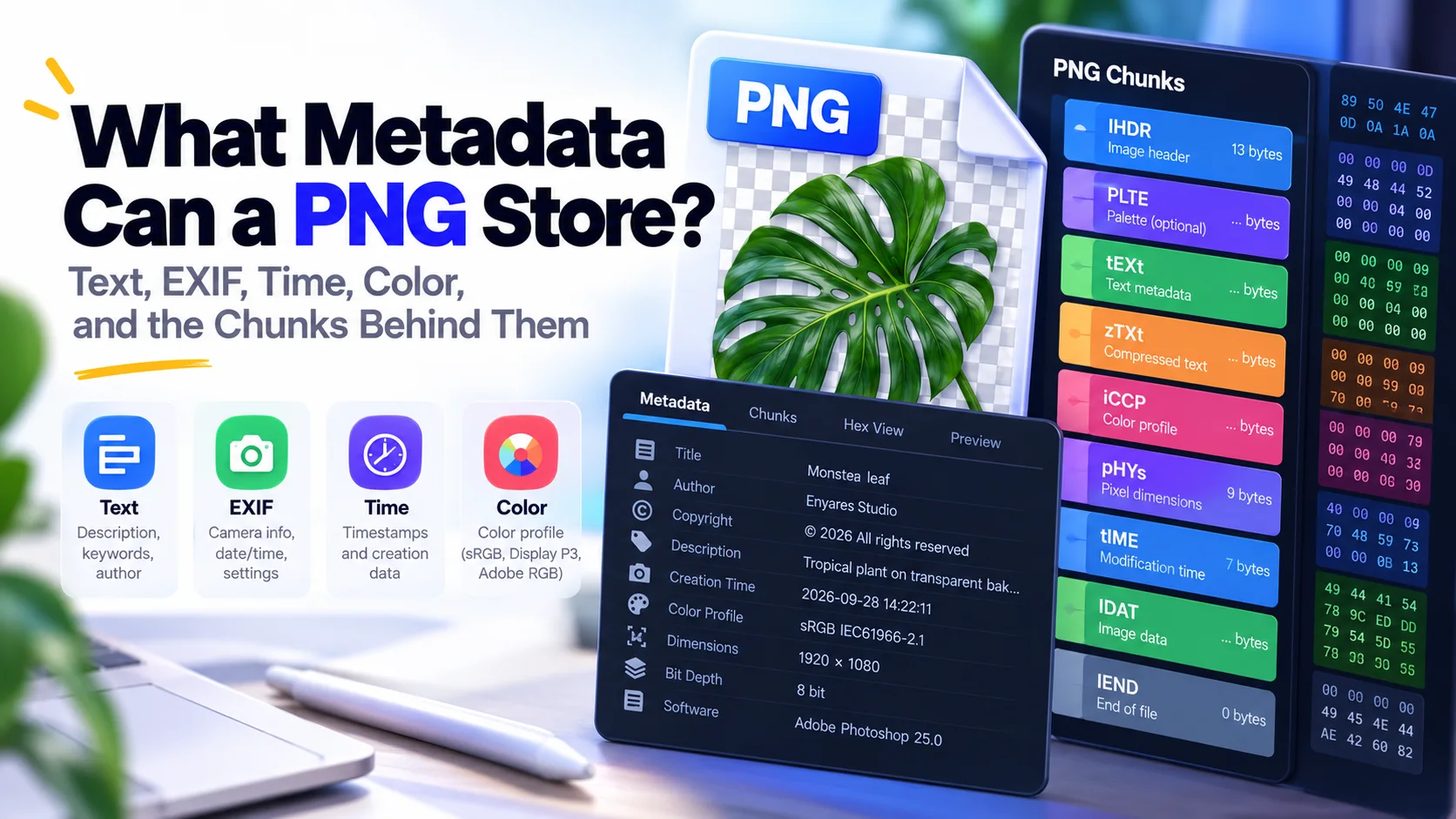
After the PNG signature, the file is organized into chunks. IHDR describes the image, IDAT carries compressed image data, and IEND closes the stream. Ancillary chunks can add information that is useful without being required to reconstruct the basic pixels.
Text has several homes
PNG defines textual chunks including tEXt, zTXt, and iTXt. They differ in encoding and compression capabilities. This is why a PNG can contain a title, description, copyright notice, or application-specific textual information without drawing that text into the image.
EXIF is part of modern PNG
The current W3C PNG specification includes the eXIf chunk. That surprises people who associate EXIF exclusively with JPEG photographs. Whether a particular editor preserves or exposes that information is a separate application question.
Color metadata is not decorative
Chunks such as iCCP, sRGB, gAMA, cHRM, and newer color signaling can influence how a color-aware decoder interprets sample values. Stripping every ancillary chunk can therefore change appearance even if the compressed pixel samples remain untouched.
There is also physical and time information
PNG can carry intended physical pixel dimensions and a last-modification time. Those fields do not magically make a 1000-pixel image print at one immutable size; applications decide how, or whether, to use the metadata.
Why optimization tools disagree
One optimizer may remove text and timestamps while retaining color information; another may be more aggressive. Two files can render identically in your browser yet differ in metadata, byte size, and suitability for archival or production workflows. Decide what information matters before selecting a 'strip all metadata' option.
Sources and technical basis
Primary technical reference: W3C Portable Network Graphics (PNG) Specification, Third Edition (2025). Web-delivery sections also use MDN guidance for responsive images where relevant.