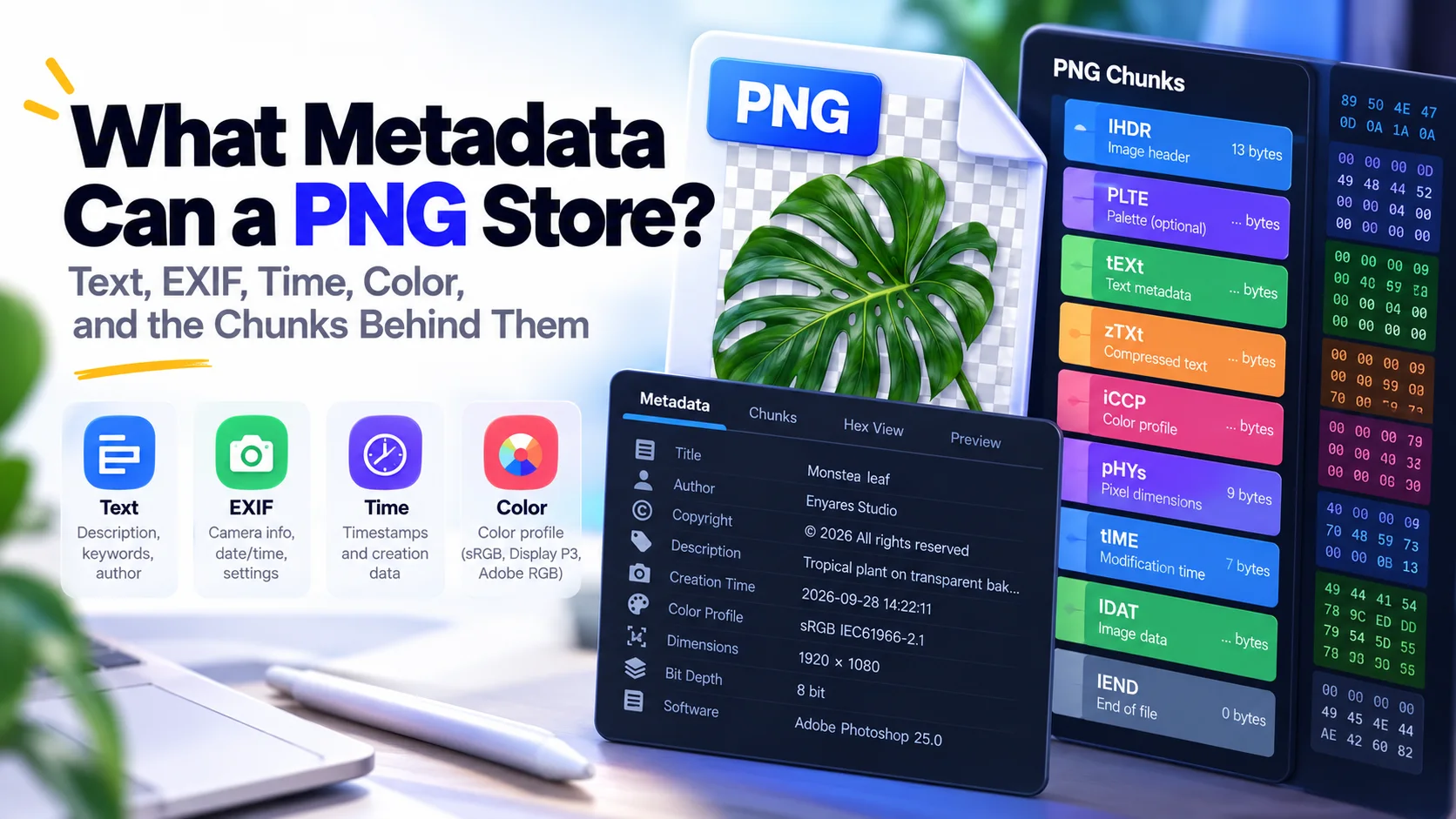
PNG was designed to be extensible. Some chunks are essential for decoding, while others add optional information that software may preserve, use, or ignore.
Four critical chunk types define the core
The PNG specification identifies IHDR, PLTE, IDAT, and IEND as critical chunk types, with PLTE required only where the color type needs a palette. A decoder must understand the critical information relevant to the image.
Ancillary does not mean useless
Transparency information for some color types, color management, text, EXIF, physical dimensions, and timestamps can live in ancillary chunks. The image may still decode without some of them, but the intended interpretation or surrounding information can change.
Chunk names carry structural signals
PNG chunk type letters are not arbitrary labels. Their uppercase/lowercase bits encode properties including whether a chunk is critical or ancillary and whether it is safe for editors to copy when they do not understand it.
Unknown extensions were anticipated
The format's extensibility model allows new ancillary chunks to appear without requiring every old decoder to know their meaning. This is a major reason a decades-old container can evolve.
Editors have responsibilities too
A program that changes image data cannot blindly copy every unknown chunk. Some metadata may no longer be valid after modification. Conversely, deleting everything unknown can discard useful application or archival information.
Why this matters in production pipelines
If an optimizer, CDN, editor, and asset-management system each rewrite PNGs, metadata can disappear at different stages. When a workflow depends on a chunk, test the entire pipeline rather than assuming a valid source file guarantees valid delivery.
Sources and technical basis
Primary technical reference: W3C Portable Network Graphics (PNG) Specification, Third Edition (2025). Web-delivery sections also use MDN guidance for responsive images where relevant.