A large transparent master is useful, but icon delivery often needs carefully rendered sizes rather than one huge PNG scaled everywhere.
Small icons are their own design problem
A mark that looks excellent at 1024 pixels can become muddy at 16 or 32 pixels. Fine gaps close, strokes become uneven, and subtle shadows turn into noise. Raster export is therefore not only a resize operation.
Start from vector or the highest-quality master
Keep the editable source separate from delivery assets. Generate PNG derivatives from that source rather than resizing a previously downsized PNG upward and downward across the pipeline.
Render target sizes deliberately
At very small dimensions, optical adjustments may improve legibility: simplifying detail, adjusting stroke weight, or changing spacing. That does not mean the brand is inconsistent; it is the same principle used in responsive iconography and typography.
Transparency needs edge testing
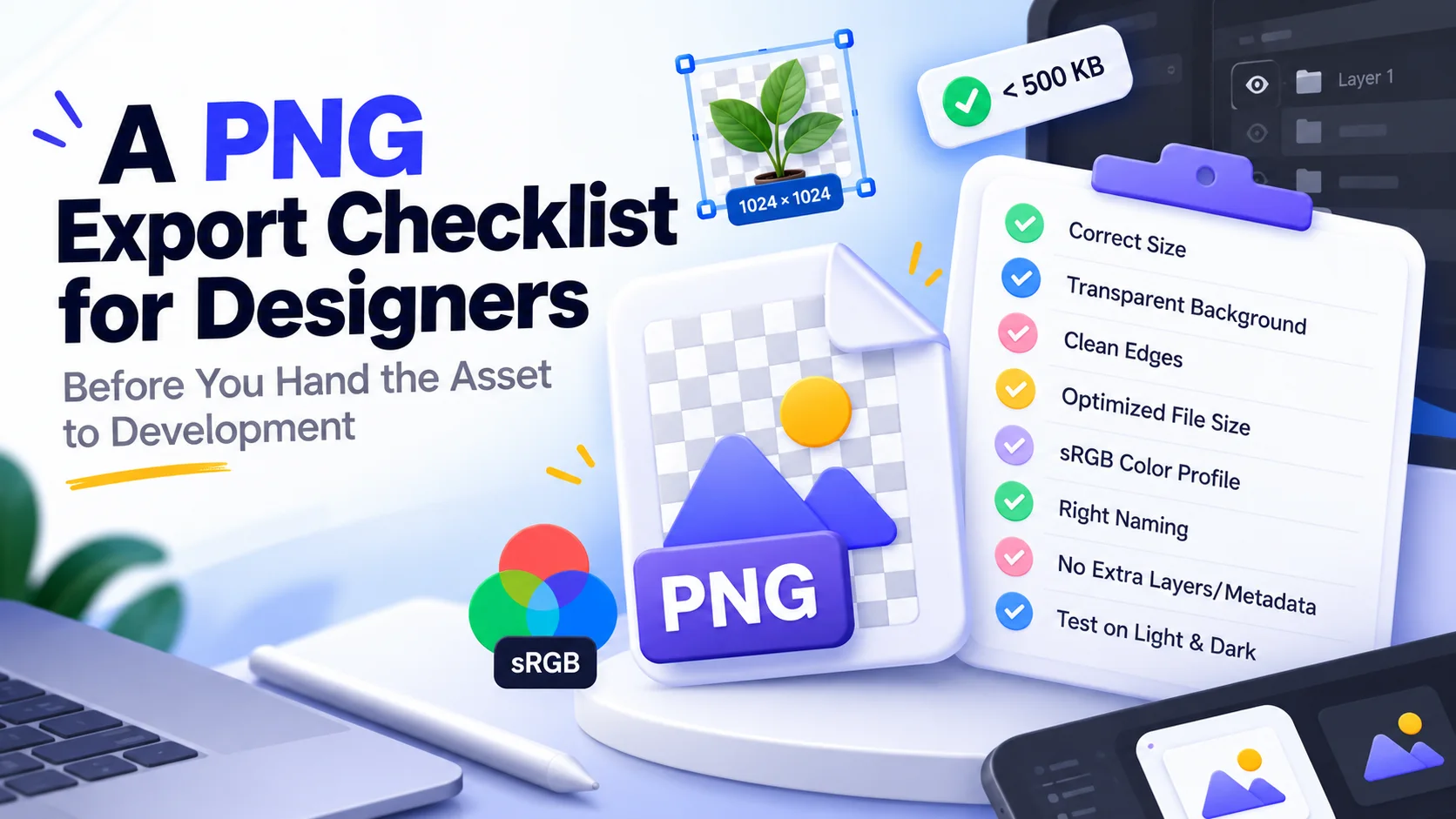
Inspect the icon on light, dark, and colored backgrounds. Small alpha-edge mistakes are more visible around high-contrast marks, particularly after platform-specific resizing.
Do not ship a 1024-pixel icon into a 32-pixel slot
Even when the platform can downscale it, the larger resource wastes transfer and decode work. Where the delivery system accepts multiple sizes, provide the sizes it actually requests.
Automate from a source of truth
A build script can generate standard derivatives, run lossless optimization, and verify dimensions. Automation is valuable only if the source and export rules are controlled; otherwise it simply reproduces the wrong asset consistently.
Sources and technical basis
Primary technical reference: W3C Portable Network Graphics (PNG) Specification, Third Edition (2025). Web-delivery sections also use MDN guidance for responsive images where relevant.